GreenGovRAG
An Open Source AI Assistant for Australian Environmental & Planning Regulations
Helping planners, consultants, and researchers navigate complex laws — faster, smarter, and cloud-agnostic.
Why GreenGovRAG Exists
Environmental and planning regulations in Australia are fragmented across federal, state, and local governments.
Planners, consultants, and ESG analysts often spend weeks digging through PDFs, council websites, and regulatory guidelines just to answer basic questions like:
- How do I calculate fugitive emissions from natural gas transmission pipelines?
- (
LGA: City of Adelaide) What heritage guidelines apply to developments in Adelaide Park Lands? - How do federal and Queensland planning laws interact for development near Great Barrier Reef?
- (
Topic: Emissions) How do I report Scope 2 emissions using market-based accounting with renewable energy certificates?
GreenGovRAG changes that.
It’s an open-source AI-powered assistant that makes navigating regulations as simple as asking a question — with citations to official sources and location-aware filtering.
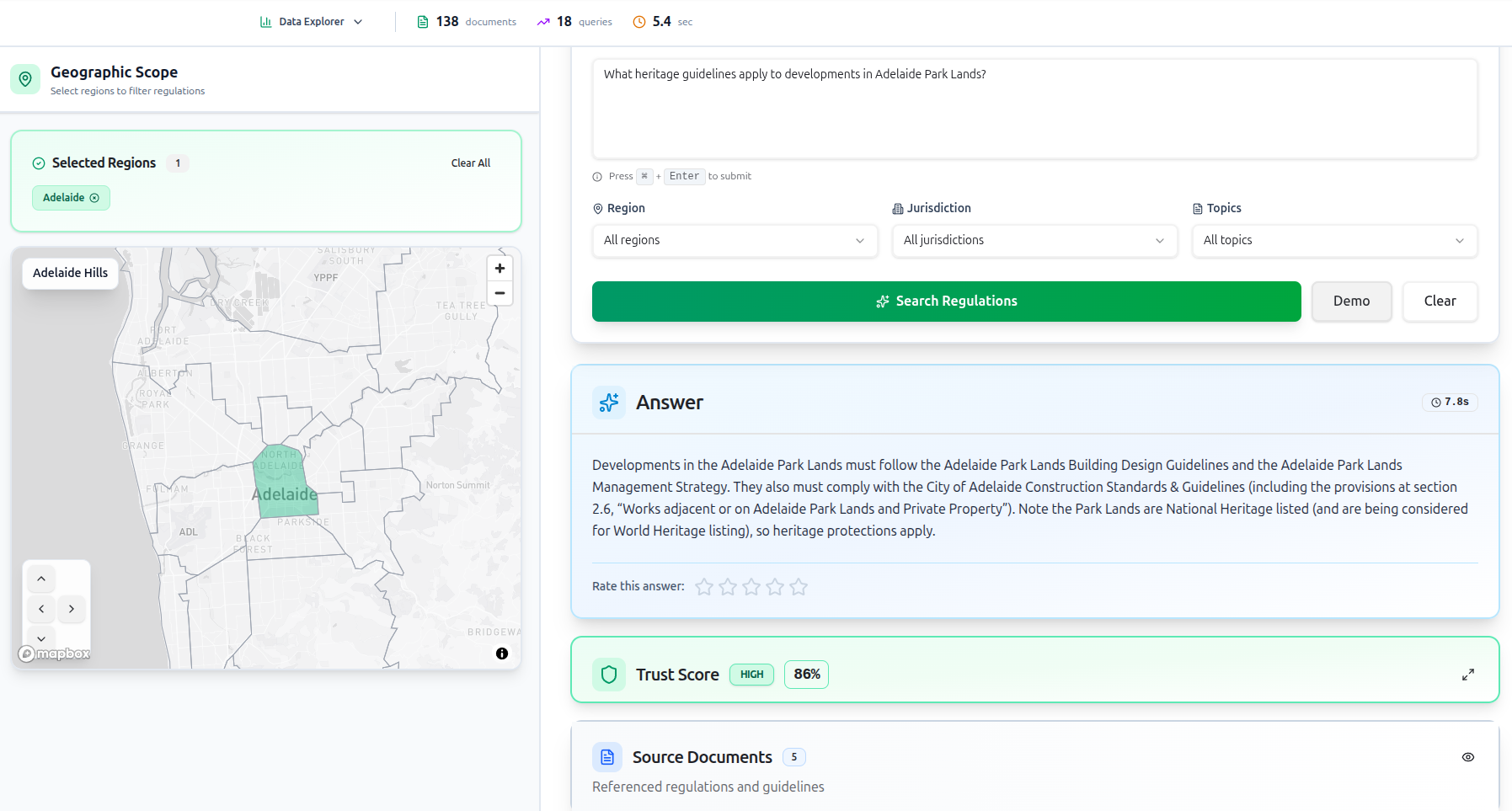
What is GreenGovRAG?
GreenGovRAG is an AI Retrieval-Augmented Generation (RAG) system tailored for Australian environmental and planning regulations.
Key Features:
- Ask questions in natural language → get relevant answers with citations
- Geo-aware search → filter by state, LGA (Local Government Area), or region
- Supports ESG reporting → climate, biodiversity, water, emissions queries
- Hybrid search → combines BM25 keyword search with vector similarity
- Cloud-agnostic deployment → works on AWS, Azure, or local Docker
- Multi-LLM support → OpenAI, Anthropic, AWS Bedrock, Azure OpenAI
- Open Source → built for contributors, civic-tech, and researchers
Source code: github.com/sdp5/green-gov-rag
Example Use Cases
1. Environmental Impact Assessment (EIA) Pre-screening
User: Environmental consultant, planner, or developer Query: “Do I need an environmental impact assessment to build a solar farm in regional NSW?”
GreenGovRAG Output:
- Summarizes relevant sections from NSW planning portal and EPBC Act
- Cites official sources with links
- Explains exemption criteria and thresholds
2. Native Vegetation Clearing Rules by Region
User: Local council officer or landowner Query: “Can I clear native vegetation near Murray Bridge, SA?”
GreenGovRAG Output:
- Retrieves SA Government vegetation clearance policies
- Uses LGA-level filtering for local rules
- Returns allowed/disallowed activities and buffer zones
3. Zoning Regulations and Permitted Uses
User: Urban planner or real estate developer Query: “What are the zoning restrictions for coastal land in Mornington Peninsula, VIC?”
GreenGovRAG Output:
- Retrieves planning scheme overlays from council documents
- Explains permitted uses, height limits, environmental constraints
4. Emissions and Energy Standards Compliance
User: Sustainability advisor or industrial developer Query: “Which emissions standards apply to industrial zones in Greater Sydney?”
GreenGovRAG Output:
- Points to NSW EPA and federal requirements
- Suggests offsets or sustainable alternatives
- Links to energy incentive schemes
How It Works (Technical Deep Dive)
GreenGovRAG combines automated ETL pipelines, RAG, and cloud-native infrastructure:
1. Data Ingestion & ETL
- Sources: EPBC Act (federal), SA/NSW/VIC legislation, council planning schemes, emissions data (CER/NGER)
- Pipeline: Apache Airflow (dev) + GitHub Actions (production)
- Processing: PDF parsing, HTML scraping, metadata tagging with LLM
- Storage: PostgreSQL with pgvector, cloud storage (S3/Azure Blob)
2. Text Chunking & Embeddings
- Chunking: Semantic chunking with 500-1000 token chunks, 100-200 token overlap
- Embeddings:
sentence-transformers/all-MiniLM-L6-v2(default, configurable) - Metadata: Preserves jurisdiction, document type, LGA, regulatory hierarchy
3. Vector Store & Hybrid Search
- Vector Stores: FAISS (local dev), Qdrant (production)
- Hybrid Search: BM25 keyword search + vector similarity
- Geospatial Filtering: LGA boundaries (GeoJSON), location NER for Australian places
4. RAG Chain & Response Generation
- LLM Providers: OpenAI (gpt-4o, gpt-4o-mini), Anthropic (Claude), AWS Bedrock, Azure OpenAI
- Response Enhancement: Trust scoring, citation verification, regulatory hierarchy
- API: FastAPI with OpenAPI docs, rate limiting, CORS support
5. Deployment Options
- AWS: ECS Fargate (backend), EC2 Spot (Qdrant), RDS PostgreSQL, CloudFront (frontend)
- Azure: Container Apps, PostgreSQL Flexible Server, Blob Storage
- Local: Docker Compose with all services
- CI/CD: GitHub Actions for automated deployments
Tech Stack:
- Backend: Python 3.12, FastAPI, SQLModel, LangChain
- Database: PostgreSQL with pgvector
- Vector Stores: FAISS, Qdrant
- Frontend: React + TypeScript (WIP)
- Deployment: Docker, AWS CDK, Azure Bicep
Why It Matters
For Planners
Saves weeks of manual research — get answers to compliance questions in seconds instead of days.
For Consultants
Supports ESG and compliance reporting — quickly find relevant regulations for environmental impact statements.
For Local Councils
Improves transparency and community engagement — make regulations more accessible to residents.
For Researchers
Builds open datasets — contribute to civic-tech and evidence-based policy.
In Adelaide and across South Australia, there’s growing interest from urban planning and sustainability groups who struggle with fragmented regulatory data.
Project Status & Roadmap
Current (v0.1.0):
- Multi-source document ingestion (federal, state, local)
- Hybrid BM25 + vector search with LGA filtering
- Multi-LLM support (OpenAI, Anthropic, Bedrock, Azure)
- Production deployments on AWS and Azure
- Automated ETL pipelines (GitHub Actions)
- API with comprehensive docs
Next Steps:
- Geographic coverage expansion — all states and territories
- Frontend improvements — interactive query interface
- ESG-specific features — carbon accounting, biodiversity metrics
- User authentication — OAuth2, usage tracking
- Real-time updates — webhook-based document refresh
Success Metrics:
- Community adoption → GitHub stars, contributors, PRs
- Utility → queries answered correctly, user feedback
- Coverage → document sources across all jurisdictions
- Engagement → demo usage, conference presentations
How You Can Help
GreenGovRAG is open-source and community-driven. Ways to contribute:
For Developers
- Contribute code, tests, or documentation
- Add new document source plugins
- Improve the frontend UI/UX
- Write integration tests
For Domain Experts
- Add your state’s/council’s regulations to the ETL pipeline
- Validate query results and provide feedback
- Suggest new use cases and features
For Advocates
- Share with planners, ESG analysts, and researchers
- Present at meetups or conferences
- Provide feedback via GitHub issues
Documentation: docs.greengovrag.sundeep.id.au
Discussions: github.com/sdp5/green-gov-rag/discussions
Quick Start
Using Docker (Recommended)
git clone https://github.com/sdp5/green-gov-rag.git
cd green-gov-rag/deploy/docker
cp .env.example .env
# Edit .env with your API keys
docker-compose up
Access:
- Backend API: http://localhost:8000/docs
- Frontend: http://localhost:3000 (WIP)
Local Development
# Backend
cd backend
pip install -e .[dev]
cp .env.example .env
alembic upgrade head
uvicorn green_gov_rag.api.main:app --reload

# Frontend
cd frontend
npm install
npm run dev
See deployment guide for AWS/Azure deployment.
What’s Next?
- Expanding coverage across all Australian states and territories
- ESG-specific reporting features for carbon, biodiversity, water
- Partnerships with civic-tech and green-tech organizations
- User authentication and multi-tenancy support
Final Word
GreenGovRAG is our step toward making environmental regulation accessible, transparent, and actionable — starting in Adelaide and scaling across Australia.
Whether you’re a planner navigating complex compliance requirements, a consultant preparing environmental assessments, or a researcher analyzing policy gaps — GreenGovRAG can help.
Join us in building it. 🌏